Showing posts with label science. Show all posts

October 7, 2013

God > science

"I only believe in science." 
- Esqueleto, from the movie Nacho Libre


I found myself browsing through Zen Pencils this weekend and resolving to read each inspirational-quote-turned-comic. I already have some strips or their original sources reposted on my Facebook and Twitter. I also have some strips that I'm excited to show to my new students next week.

And then I reach this. 


Which led me to respond with the following comment:


There are many scientists who are Christians too, myself included. I decided to go into physics after reading Carl Sagan's books and watching Cosmos (and the X-Files). Sagan also led me to become an agnostic/passive atheist, but after a life tragedy I found myself reading the Bible with one -- nay, two -- eyes open.
 

Christianity makes sense to me in the same way that physics does. Of course, God is way more complicated - but what relationship isn't? We sometimes cannot figure out ourselves, how much less the people around us, and how much less a *supreme being*? This reasoning does not automatically prove there is a God, but I'm just saying there are a lot of things that are beyond science.
 

Science gives a lot of benefits but also has a lot of limitations. Science demands repetition and predictability and numbers -- does art have this? Do we then say that art is foolishness, or that art does not exist? Wouldn't that be the foolish thing to say?

The wonder and awe for the universe that Carl Sagan gave me is still there. But in my humble opinion, it has now matured to include the Creator. Sagan hastily dismissed all world religions as superstitious falsehood and wishful thinking, yet was quite convinced of the existence of extraterrestrial life even though he had no proof himself (it's easy to give equations, but somebody please show me one alien being now). If one applies scientific skepticism to reject deistic/theistic beliefs, it is but fair to apply that same skepticism to one's own pet beliefs too.


On the other hand, Christians nowadays do tend to ignore the *first* commandment to love God with our mind (as well as heart, body, and soul). But I'm proud to say that I know many people who use science to honor God and even know Him more. As for me, I write a Bible verse on the board before beginning my college physics class. ♥

God be with you more Gav! I share your admiration for Sagan but also for Christian authors like CS Lewis and Marianne Williamson. I hope you find Him as you seek and share even more inspiration to the world.

May 5, 2012

Build up the kids, you build up the future :)

The constructive approach is constructive; the destructive/punitive approach is destructive.

This is a very good read whether you're in the academe or not. It explores the psychological, emotional, and biological effects of constructive education:

Lincoln High School in Walla Walla, WA, tries new approach to school discipline — suspensions drop 85%


“If you are struggling with depression or anxiety, you’re going to have a much harder time concentrating in school and being able to complete your work.”  

“We tell our kids we love them. They’re important to us.”

“When students understand they’re not responsible for the family they were born into, but they are responsible for who they will become as adults, and when they can see the power in that, it’s just amazing what happens.” 

"We accept them for who they are. Their future is more important than their past.” 

"One of the keys has been a staff that embraces two basic concepts: toxic stress prevents kids from learning, and moving from a punitive approach to a supportive, educational approach changes behavior. Gordon says it’s also the unconditional love that the teachers at Lincoln High show the kids on a regular basis."

April 30, 2012

thesis it. ;)

Alryty, so I have so many questions about stuff. (Mainly love life hahaha.)

And ever the optimist, I just look at it this way:

At least, my thesis is doable.

Thesis it! The time, the funds, the energy, the attitude, the inclination, plus all the motivation to finally do it.

So help me God. :)


James 4:13-15:
     Come now, you who say, “Today or tomorrow we will go into such and such a town and spend a year there and trade and make a profit” — yet you do not know what tomorrow will bring.
     What is your life? For you are a mist that appears for a little time and then vanishes.
     Instead you ought to say, “If the Lord wills, we will live and do this or that.”

April 26, 2012

All booked up :)

Yesterday I bought two books. (Yes, I'm a Jesus freak and a bookworm.)

One is from Anne Graham Lotz, daughter of the great preacher Billy Graham. Billy calls her the best preacher in the family. I can see why:

"My duties and responsibilities at times seem overwhelming
and my schedule is overfilled.
But I don't want a vacation,
I don't want to quit,
I don't want sympathy,
I don't want money,
I don't want recognition,
I don't want to escape,
I don't even want a miracle!...

"Just give me JESUS."


Yep. Forget the problems and even the blessings... Let's go back to God Himself.


The other book I bought is the popular contemporary Bible translation, "The Message". I've been "craving" for it for some time already --- from the verses I've heard, Mr. Eugene Peterson talks straight and talks street. God's Truth is supposed to be sharper than a double-edged sword and The Message does deliver that truth in a powerful and (for people who've read the Bible for years) fresh way.

However, there are (quite valid) oppositions to The Message, such as found here and here.

What to do? The same thing a good Christian, a good scientist, or any person for that matter should do. Check, test, verify. 

The Christ-believers in Berea used the scientific method two thousand years ago:

"Now the Bereans were of more noble character than the Thessalonians, for they received the message with great eagerness and examined the Scriptures every day to see if what Paul said was true." - The Book of Acts


Alrighty. Receive with an open heart ("great eagerness") but also an open mind ("examined to see if... true"). To apply to this situation, read The Message with "great eagerness" but continue to read the other versions of the Bible as well --- the others already established as authentic. 

Any Bible translation is a human and therefore feeble attempt to record and resend the Word of God Himself. However, if it is True, then it would be able to shine a different facet of the same God-diamond.


That's it. Enough blogging. Now to sleep, and tomorrow, to read. :)

July 12, 2011

Natural science and supernatural God

"The scientific explanation for human origins does not admit a supreme being as the creator of life and humans. This is not a rejection or denial of God, merely an acceptance of the limitations of science. By its very nature, science is unable to deal with a supernatural being. Science deals only with nature, with the materials, processes, and life forms of the natural world. God is, by definition, beyond the investigative powers of science."
-  George D. Brown, Jr., "Human Evolution"

February 19, 2009

The "Ph" in a PhD: Philosophy issues in Science

These excerpts talk about science in a universe that cannot be exclusively understood in terms of it. From the "Science" article of Wikipedia.


Philosophical focus

Historian Jacques Barzun termed science "a faith as fanatical as any in history" and warned against the use of scientific thought to suppress considerations of meaning as integral to human existence.[27]
Many recent thinkers, such as Carolyn Merchant, Theodor Adorno and E. F. Schumacher considered that the 17th century scientific revolution shifted science from a focus on understanding nature, or wisdom, to a focus on manipulating nature, i.e. power, and that science's emphasis on manipulating nature leads it inevitably to manipulate people, as well.[28]
Science's focus on quantitative measures has led to critiques that it is unable to recognize important qualitative aspects of the world.[28] It is not clear, however, if this kind of criticism is adequate to a vast number of non-experimental scientifics fields like astronomy, cosmology, evolutionary biology, complexity theory, paleontology, paleoanthropology, archeology, earth sciences, climatology, ecology and other sciences, like statistical physics of irreversible non-linear systems, that emphasize systemic and historically contingent frozen accidents.
Considerations about the philosophical impact of science to the discussion of the meaning (or lack thereof) in human existence are not suppressed but strongly discussed in the literature of science divulgation, a movement sometimes called The Third Culture.
The implications of the ideological denial of ethics for the practice of science itself in terms of fraud, plagiarism, and data falsification, has been criticized by several academics. In "Science and Ethics", the philosopher Bernard Rollin examines the ideology that denies the relevance of ethics to science, and argues in favor of making education in ethics part and parcel of scientific training.[29]


Epistemological issues

Psychologist Carl Jung believed that though science attempted to understand all of nature, the experimental method used would pose artificial, conditional questions that evoke only partial answers.[34]

Robert Anton Wilson criticized science for using instruments to ask questions that produce answers only meaningful in terms of the instrument, and that there was no such thing as a completely objective vantage point from which to view the results of science.[35]

Parkin suggests that, compared to other ways of knowing (ex.
divination), the epistemological stance of science is on the same spectrum as any other approach; it is simply in a different area of the range in terms of its specific techniques and processes.[36] In this sense, to the degree that divination is an epistemologically specific means of gaining insight into a given question, Parkin suggests that science itself can be considered a form of divination that is framed from a Western view of the nature (and thus possible applications) of knowledge (i.e. a Western epistemology).

June 23, 2008

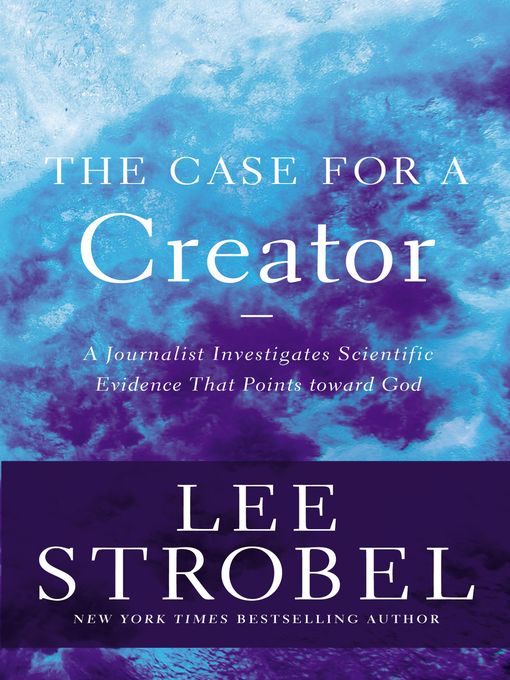
[Book] "The Case For A Creator"

The Case For A Creator
By: Lee Strobel
Zondervan / 2004 / Hardcover

Book Description:
From evolutionary icons to the uniqueness of planet Earth, from irreducible complexity to the kalam cosmological argument, Lee Strobel gives full rein to his keen analytical mind in addressing these issues and more. But don't expect an inaccessible tome of arcane scientific terms; Strobel's years of newspaper reporting gives the book a conversational style. Relying on transcriptions of his interviews with experts in the pertinent fields, he tells the incredible stories about the hard science behind what some have termed creationism. Extensively researched, this book should be a classic apologetic text for years to come.

Publisher's Description:
Lee Strobel investigates the latest scientific discoveries to see whether they form a solid basis for believing in God.

Publisher's Weekly:
Strobel, whose apologetics titles The Case for Christ and The Case for Faith have enjoyed strong popularity among evangelicals, approaches creation/evolution issues in the same simple and energetic style. The format will be familiar to readers of previous Case books: Strobel visits with scholars and researchers and works each interview into a topical outline. Although Strobel does not interview any "hostile" witnesses, he exposes readers to the work of some major origins researchers (including Jonathan Wells, Stephen Meyer and Michael Behe) and theistic philosophers (including William Lane Craig and J. P. Moreland). Strobel claims no expertise in science or metaphysics, but as an interviewer he makes this an asset, prodding his sources to translate jargon and provide illustrations for their arguments. At times, the interview format loses momentum as seams begin to show between interview recordings, rewrites, research notes and details imported from his subjects' CVs (here, Strobel's efforts at buffing his subjects' smart-guy credentials can become a little too intense). The most curious feature of the book-not uncommon in the origins literature but unusual in a work of Christian apologetics-is that biblical narratives and images of creation, and the significance of creation for Christian theology, receive such brief mention. Still, this solid introduction to the most important topics in origins debates is highly accessible and packs a good argumentative punch. (Apr.) Forecast: Strobel's books The Case for Christ and The Case for Faith won Gold Medallion awards and sold into the seven figures. This month, also watch for his The Case for Easter to argue for the historical authenticity of the Resurrection (Feb.) Copyright 2004 Reed Business Information.

Editorial Reviews:
"…Strobel exposes the shortcomings of Darwin’s theory of evolution quite effectively…Strobel insists that with a fresh examination of the evidence which science now presents, Darwin’s theory of evolution is no longer reasonable. There are too many gaps, unexplained hypotheses and conceptual flaws…This is an excellent book for those who wish to think seriously through the theory of evolution, and for those who continue to wrestle with Christianity’s claims for a creator God. It is well written, the documentation is verifiable and Strobel’s skills as a journalist and lawyer are self-evident in the book’s composition…" —
Christian Week -- Prince George, B.C.

"… While the subject matter is complicated and 'heavy in the head', Strobel presents the information in a highly fluid, conversational manner. While science may not have discovered God, he finds that science is giving faith an immense boost as new findings emerge about the incredible complexity of the universe." — Carroll County News -- Alan Long (CNN Faith Editor)

Customer Reviews:
Average Rating:
5 out of 5 stars, 3 of 3 Reviews Showing:

5 out of 5 stars,
Reviewed by Vonny Kusumawati (California), April 03, 2007

Great book. I was taught many of the false and misleading scientific discoveries through out college. I'm glad that I found this book. It's a must read for everyone involved in children, teenager and youth ministries.

5 out of 5 stars,Reviewed by Heather Kuruvilla (Xenia, OH), May 24, 2005

This book is awesome! It was a great encouragement to me, as a scientist. I wish more young scientists would read it.

4.5 out of 5 stars,Reviewed by Alan (Daphne, AL), February 27, 2005

A must read for anyone interested in apologetics. The theories can be a little difficult to grasp at times, but Strobel does an excellent job of portraying it all in a fairly understandable manner. Very enlightening.

[Book] "Galileo, Darwin, and Hawking: The Interplay of Science, Reason, and Religion"

Galileo, Darwin, and Hawking: The Interplay of Science, Reason, and Religion
By: Phil Dowe
Wm. B. Eerdmans Publishing Co. / 2005 / Paperback

Book Description:
First, Dowe sketches in a concise introduction to the philosophy of science; then he ably defends the "interaction view," which sees science and religion as essentially complementary. Focuses on the lives of Galileo, Darwin, and Hawking, and those conflicted issues of cosmology, evolution, and miracles. 205 pages, softcover. Eerdmans.

[Book] "Why the Science and Religion Dialogue Matters"

Why the Science and Religion Dialogue Matters
Voices from the International Society for Science and Religion
Edited by Fraser Watts and Kevin Dutton
October 2006, 6 x 9, 168 pages
Book Description:
Each world faith tradition has its own distinctive relationship with science, and the science-religion dialogue benefits from a greater awareness of what this relationship is. In this book, members of the International Society for Science and Religion (ISSR) offer international and multi-faith perspectives on how new discoveries in science are met with insights regarding spiritual realities.
The essays reflect the conviction that “religion and science each proceed best when they’re pursued in dialogue with each other, and also that our fragmented and divided world would benefit more from a stronger dialogue between science and religion.” In Part One, George F. R. Ellis, John C. Polkinghorne, and Holmes Rolston III, each a Templeton Prize winner, discuss their views on why the science and religion dialogue matters. They are joined in Part Two by distinguished theologians Fraser Watts and Philip Clayton, who place the dialogue in an international context; John Polkinghorne’s inaugural address to the ISSR in 2002 is also included. In Part Three, five members of the ISSR look at the distinctive relationships of their faiths to science:
  • Carl Feit on Judaism
  • Munawar Anees on Islam
  • B.V. Subbarayappa on Hinduism
  • Trinh Xuan Thuan on Buddhism
  • Heup Young Kim on Asian Christianity
George Ellis, the recently elected second president of ISSR, summarizes the contributions of his colleagues. Ronald Cole-Turner then concludes the book with a discussion of the future of the science and religion dialogue.
Highlights:
  • Theological insights from an international perspective
  • First collection of essays from the International Society for Science and Religion
  • Offers multi-faith perspectives from Islamic, Hindu, Buddhist, Jewish, and Asian-Christian viewpoints

[Book] "Science and Religion"

Science and Religion
A Critical Survey
With a New Introduction
Holmes Rolston III
September 2006, 6 x 9, 408 pages


Book Description:
This landmark book, first published in 1987, is now back in print, with a new introduction by its award-winning author. An interdisciplinary approach to the central themes of scientific and religious thought, this book was widely heralded upon its publication for the richness and depth of its contribution to the science and religion dialogue.
According to Holmes Rolston III, there are fundamental questions that science alone cannot answer; these questions are the central religious questions. He uses the scientific method of inquiry to distill key issues from science, and then he integrates them in a study that begins with matter and moves through life, mind, culture, history, and spirit.
Incorporating religious and scientific worldviews, he begins with an examination of two natural sciences: physics and biology. He then extrapolates examples from two human sciences: psychology and sociology. Next, he moves to the storied universe and world history, raising and addressing religious questions. “Never in the histories of science and religion have the opportunities been greater for fertile interaction between these fields, with mutual benefits to both,” states Rolston.The re-publication of this book provides current researchers and students in the field an invaluable, timeless methodological resource.The new introduction offers updated insights based on new scientific research.
Reviews:
“notable for its breadth and depth . . . filled with admirably argued and powerfully presented treatments of critical issues.”—Joseph Pickle, Colorado College, Zygon: Journal of Religion and Science
“a superb and subtle book.”—David Foxgrover, Christian Century
“a monumental work . . . [T]he book is truly outstanding.”—John H. Wright, Jesuit School of Theology, Berkeley, Theological Studies
“Rolston’s presentation of the methods of science, along with up-to-date summaries of the main achievements of the various sciences, is commendable for its clarity and critical acumen.”—Choice
Highlights
  • Twentieth anniversary paperback of a landmark text in the science and religion dialogue
  • Includes new introduction by the author
  • A timeless classic now available again

[Book] "The Foundations of Dialogue in Science and Religion"

The Foundations of Dialogue in Science and Religion
By:
Alister E. McGrath
Blackwell Publishing / 1999 / Hardcover

Book Description:
In this book, Alister McGrath explores the relation of religion and the natural sciences, focusing specifically on Christianity as a case study. The book explores the way in which religions and the natural sciences differ from each other, yet converge on matters of considerable interest in a number of areas.

[Book] "The Language of God: A Scientist Presents Evidence for Belief"

The Language of God: A Scientist Presents Evidence for Belief
By:
Francis S. Collins
Free Press / Hardcover


Book Description:
Collins, a former atheist, but most notably the head of the Human Genome Project, presents BioLogos (theistic evolution) for a new generation. Comparing it to atheistic evolution, Intelligent Design (ID) and creationism, he highlights the good points of this proposition that God directed evolution to its resolution in mankind. Working within this framework, he details BioLogosian logic about the origin of life, hypotheses from the Human Genome Project, and bioethics.

Publisher's Description:
Does science necessarily undermine faith in God? Or could it actually support faith? Beyond the flashpoint debates over the teaching of evolution, or stem-cell research, most of us struggle with contradictions concerning life's ultimate question. We know that accidents happen, but we believe we are on earth for a reason. Until now, most scientists have argued that science and faith occupy distinct arenas. Francis Collins, a former atheist as a science student who converted to faith as he became a doctor, is about to change that.

Collins's faith in God has been confirmed and enhanced by the revolutionary discoveries in biology that he has helped to oversee. He has absorbed the arguments for atheism of many scientists and pundits, and he can refute them. Darwinian evolution occurs, yet, as he explains, it cannot fully explain human nature -- evolution can and must be directed by God. He offers an inspiring tour of the human genome to show the miraculous nature of God's instruction book. Sure to be compared with C.S. Lewis's Mere Christianity, this is a stunning document, whether you are a believer, a seeker, or an atheist.

Library Journal:

When the head of the Human Genome Project calls the genetic code "the language of God," he deserves to be taken very seriously. In a discussion that is both broadly ecumenical and scientifically incontrovertible, Collins entertains propositions both for and against the existence of God and biblical authority, as well as the moral implications of bioethics. He personalizes the narrative by recounting his own journey from atheism to faith, portraying it as much an intellectual quest as a spiritual one. His excellent discussion of intelligent design seeks not to debunk the theory, but rather to cite its limitations and to show how a scientific worldview transcends them without, in his opinion, conflicting with faith. Finally, he talks about his vision of "BioLogos," or science and religion in harmony. An essential read, equally for readers of religious or secular persuasions. Copyright 2006 Reed Business Information.

Publisher's Weekly:
Collins, a pioneering medical geneticist who once headed the Human Genome Project, adapts his title from President Clinton's remarks announcing completion of the first phase of the project in 2000: "Today we are learning the language in which God created life." Collins explains that as a Christian believer, "the experience of sequencing the human genome, and uncovering this most remarkable of all texts, was both a stunning scientific achievement and an occasion of worship." This marvelous book combines a personal account of Collins's faith and experiences as a genetics researcher with discussions of more general topics of science and spirituality, especially centering around evolution. Following the lead of C.S. Lewis, whose Mere Christianity was influential in Collins's conversion from atheism, the book argues that belief in a transcendent, personal God-and even the possibility of an occasional miracle-can and should coexist with a scientific picture of the world that includes evolution. Addressing in turn fellow scientists and fellow believers, Collins insists that "science is not threatened by God; it is enhanced" and "God is most certainly not threatened by science; He made it all possible." Collins's credibility as a scientist and his sincerity as a believer make for an engaging combination, especially for those who, like him, resist being forced to choose between science and God. (July 17) Copyright 2006 Reed Business Information.

Editorial Reviews:
"What an elegantly written book. In it Francis Collins, the eminent scientist, tells why he is also a devout believer.... A real godsend for those with questioning minds but who are also attracted to things spiritual." -- Archbishop Desmond Tutu


"The world respects Francis as a brilliant scientist responsible for breakthrough discoveries benefiting mankind. For a decade I have been privileged to admire him as a devoted family man and talented musician with a charmingly sharp wit. This intellectually honest, spiritually grounded reconciliation of God and science helps answer your greatest questions. I was profoundly enlightened and believe this important book should be required reading." -- Naomi Judd

"Francis Collins, one of the world's most distinguished scientists, treats the relationship of science and religion with reason and reverence. Collins's mix of clear technical exposition and personal reflection is infused with an intellectual and spiritual honesty. Everyone who questions how religious faith could be reconciled with scientific knowledge, everyone who fears that modern science attacks the heart of religious faith, everyone interested in an enlightened discussion of a crucial issue of our time should read this book." -- William D. Phillips, 1997 Nobel Laureate in Physics

"In today's world, scarred by cultural warfare, it is rare for a scientist to offer a testimony of faith in God. For that scientist to be one of the world's most renowned is rarer still. For his testimony to be so lucid and compelling, combining reason and revelation, science and spirit, is unheard of. The Language of God belongs on the shelf of every believer and every seeker." -- Dr. Robert H. Schuller, Founding Pastor, the Crystal Cathedral

Customer Reviews:
Average Rating:
4 out of 5 stars, 4 of 4 Reviews Showing:

4 out of 5 stars Reviewed by Andrew (Istanbul, Turkey), February 18, 2008

As a former Christian who became an atheist over several years of hard inquiry, I read this book to see if I had missed anything. In short, not theologically. His arguments do not adequately take the last few decades of serious New Testament biblical scholarship into account. In not doing so, they also fail to answer the key questions of why one particular system of belief and not another one. Moving from knowledge gap and intuition, to death on the cross is just too big of a leap for me. His spiritualism is heartfelt and real. However, it really does not provide much in the way of evidence for belief. It would not surprise me if his publisher wrote the title. It did remind me yet again, however, of what atheists are missing. His very honest, intelligent, and passionate discussion of his reasons for moving toward a more spiritual life was very humanistic and respectful in a way that, unfortunately, is missing these days from the increasingly vitriolic atheist camp. It is ironic that we who espouse humanism cannot be more humanistic. In terms of shear decency and who most readers would rather share the planet with, Collins puts the current crop of popular atheist authors to shame.

2 out of 5 stars Reviewed by Mary Jo Burchart (Orion, MI), October 12, 2007

As a Christian and a scientist, I was eager to read Dr. Collins' book. I found it very intriguing, as cellular and molecular biology is my concentration. However, if you believe that the Bible is the inerrant Word of God, you will have a hard time reconciling Dr. Collins' Biologos with Genesis. He considers this book more "allegory and poetry". I was disappointed.

5 out of 5 stars Reviewed by BW (Northwest Ohio), February 14, 2007

This book is incredible! As a science teacher AND a Christian believer, Francis Collins filled in a lot of gaps that tend to separate the two. His book is highly readable and thought-provoking. What a treat!

5 out of 5 stars Reviewed by David Buchanan (Stillwater, OK), February 09, 2007

Francis Collins is the Director of the Human Genome Project. This makes him one of the most recognizable scientists in America. He is also a Christian. “The Language of God” is his very public assertion that it is possible to be a person of science and a person of faith simultaneously. He has been joined recently by other scientist-believers (Owen Gingerich – Astronomy, Harvard University; Joan Roughgarden – Evolutionary Biology, Stanford University) in making this assertion (“God’s Universe” and “Evolution and Christian Faith: Reflections of an Evolutionary Biologist”, respectively). Collin’s book covers a lot of territory. He presents his autobiography, his testimony and a brief history of the Human Genome Project. He also presents his views on naturalism, intelligent design, creationism and his preferred view, theistic evolution, which he would like to rechristen as “BioLogos”. In addition, he discusses current genetic-medical issues such as stem-cell research and cloning. Despite its wide range, the book is relatively brief and highly readable. It is both thoughtful and thought-provoking.

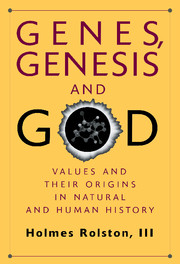
[Book] "Genes, Genesis and God"

Genes, Genesis and God
By:
Holmes Rolston III
Cambridge University Press / 1999 / Paperback

Book Description:
(PUB Cambridge University) Features the famous Gifford Lectures delivered at the University of Edinburgh in November 1997, including a stinging critique of Richard Dawkins's "selfish gene" and Edward O. Wilson's "sociobiology." "One of the most sober and intelligent voices in the discussion between biology and theology,"---Christian Century. 400 pages, softcover.

Customer Review:
0 out of 5 stars, 1 out of 1 reviewby Charles Wright (Spring, Texas), September 11, 2005


The book takes upon faith that evolution is indeed the vehicle by which man has evolved. The main argument for evolution in the book is based on computer simulations of complex computer programs programming themselves and thereby evolving (what the author fails to find is that the computer, nor the program performing the programming, assembled themselves but were rather specifically built to perform that task). The author also tries to discredit God as a mere desire derived from the human condition and fails to identify distinct differences between animal and man.

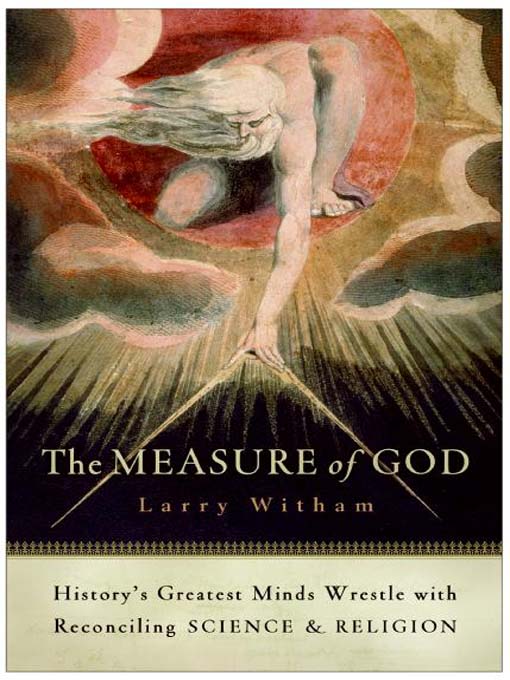
[Book] "The Measure of God: History's Greatest Minds Wrestle with Reconciling Science & Religion"

The Measure of God: History's Greatest Minds Wrestle with Reconciling Science & Religion
By:
Larry Witham
HarperOne / 2006 / Paperback

Book Description: "Witham has managed the impossible: to tell a coherent story about the diverse and often eccentric Gifford Lectures from their beginning. Telling this involves not only reading the lectures, but also knowing the social, political, and intellectual background of the various lecturers,"---Christian Century. 368 pages, softcover. HarperSanFrancisco.

Publisher's Description:

The Measure of God, now in paperback, is a lively historical narrative offering the reader a sense for what has taken place in the God and science debate over the past century.
Modern science came of age at the cusp of the twentieth century. It was a period marked by discovery of radio waves and x rays, use of the first skyscraper, automobile, cinema, and vaccine, and rise of the quantum theory of the atom. This was the close of the Victorian age, and the beginning of the first great wave of scientific challenges to the religious beliefs of the Christian world.
Religious thinkers were having to brace themselves. Some raced to show that science did not undermine religious belief. Others tried to reconcile science and faith, and even to show that the tools of science, facts and reason, could support knowledge of God. In the English speaking world, many had espoused such a project, but one figure stands out. Before his death in 1887, the Scottish judge Adam Gifford endowed the Gifford Lectures to keep this debate going, a science haunted debate on "all questions about man's conception of God or the Infinite." The list of Gifford lecturers is a veritable Who's Who of modern scientists, philosophers and theologians: from William James to Karl Barth, Albert Schweitzer to Reinhold Niebuhr, Niels Bohr to Iris Murdoch, from John Dewey to Mary Douglas.
Author Bio:
Larry Witham is the author of The Measure of God, Where Darwin Meets the Bible, and By Design: Science and the Search for God. As a journalist, he has won the Religion Communicators Council's Wilbur Award three times and has received several prizes from the Religion Newswriters Association as well as a Templeton Foundation award for his articles on science and religion.

[Book] "God's Mechanics: How Scientists and Engineers Make Sense of Religion"

God's Mechanics: How Scientists and Engineers Make Sense of Religion
By: Guy Consolmagno Jossey-Bass / 2007 / Hardcover


Product Description:
In God's Mechanics Brother Guy tells the stories of those who identify with the scientific mindset--so-called "techies"--while practicing religion. A full fledged techie himself, he relates some classic philosophical reflections, his interviews with dozens of fellow techies, and his own personal take on his Catholic beliefs to provide, like a set of "worked out sample problems," the hard data on the challenges and joys of embracing a life of faith as a techie. And he also gives a roadmap of the traps that can befall an unwary techie believer. With lively prose and wry humor, Brother Guy shows how he not only believes in God but gives religion an honored place alongside science in his life. This book offers an engaging look at how--and why--scientists and those with technological leanings can hold profound, "unaprovable" religious beliefs while working in highly empirical fields. Through his own experience and interviews with other scientists and engineers who profess faith, Brother Guy explores how religious beliefs and practices make sense to those who are deeply rooted in the world of technology.

Publisher's Weekly:
Sidestepping the acrimony of recent science vs. religion debates, Consolmagno, a Vatican astronomer and self-described "techie," intends that "demonstrating the existence of a lot of people like me, who flourish as scientists while practicing a religion, should be proof enough that science and religion can be perfectly compatible." Combining personal memoir with conversations within the techie world, Consolmagno describes questions about the universe and the meaning of life that attract techies into religious belief and practice, concluding that "techies are not looking for proof. They're looking for confidence." When he tests his initial hypotheses with a survey project, Consolmagno finds that for many religiously-involved techie types, the value of community and moral support may actually be more important than the search for religious answers. As one atheist interviewee puts it, "You think you are selling truth, but your audience has already brought their own truth with them to church. All you are selling them is tech support." Is this all there is to religion? Certainly not for Brother Guy, who defends a specifically Christian and Catholic version of religious truth. Yet Consolmagno's adroit and self-effacing style defuses any suggestion of theological point-scoring, as in his dryly Dilbertian defense of papal infallibility: "Unlike some of the other bosses I've worked for in my life, this one admits that he's only infallible under certain extremely limited conditions." (Nov.) Copyright 2007 Reed Business Information.

[Book] "Can a Smart Person Believe in God?"


Can A Smart Person Believe in God? By: Michael Guillen Nelson Books / 2006 / Paperback

Product Description:
* Is Christianity "intellectual suicide"? Does finding God mean losing your mind? Theoretical physicist and former ABC News science correspondent Guillen explains how creation often reveals its Creator; explores the compatibility between God's Word and his world; and emphasizes the fact that accepting Christ doesn't require rejecting the brain he gave you. 176 pages, softcover from Nelson.


Publisher's Description:
As Christians, we are often urged to turn away from scientific discovery and rely solely on the Bible as the source of our faith. On the other hand, many people in areas such as science, law, and education insist that Christian faith is lowbrow or unintelligent. But is it possible to reconcile science with what you believe about God? As someone who has grappled with the issues of science and faith in the public eye for more than a decade as a television journalist, Dr. Michael Guillen believes it is possible. In fact, by embracing the discoveries of science we can see God, the universe, and humanity in full, multidimensional glory.

Fortunately, you don’t have to be a genius to enjoy this book. The bite-sized chapters are full of fascinating scientific tidbits in an easy-to-understand format. Captivating stories of the author’s childhood in the Mexican barrio of East L.A. and his work in television and research are woven throughout. There is even an entertaining SQ (Spiritual Quotient) test for readers to take.

ChristianBookPreviews.Com:
This is a tremendous work that covers such a broad spectrum of society - past and present. One way for us to understand, and effectively arm ourselves, to face strong opposition by anti-Christian trains of thought is to learn how they think. We must hear their arguments, learn their viewpoints, and then respond with faith-filled knowledge. The author helps us gain this insight and understanding even in the divided camp of those who oppose Christ and the Christian belief system.

Each of the tenets of disbelief are presented and exposed for the propaganda that they are. Once their disguise is removed and their implausibility uncovered, many arguments become little more than school yard gossip. Guillen provides many impressive examples of Christian contributions to the world and the many trains of thought that had their foundation in religion or spirituality.

At some points the author's brave use of the word ‘religious’ seems, at face value, to contradict much of what he has established. However, after short reflection, his motives become more obvious—readers are encouraged to use discernment when evaluating his points.

If you desire to know where you are right now as a Christian, this book offers a splendid buffet of concepts and ideas to contemplate, explore, and use to measure our relative position in our walk of faith. Even more, this remarkable work proved to augment the arsenal of the Christian, giving depth and broader perspectives on our fundamental belief system.

What is SQ? If you don't know, or more importantly, if you want to evaluate yours, this book will bring it all into focus and help understand this charming concept.

In a time of growing false religions and science-founded beliefs, this book provides an inside out look at those beliefs against God and the ironies within. The author states, "Bottom line: I've yet to come across any atheist argument that injures my faith even a little bit…I found all of their disputations to be naive, even childish." A mini-textbook of Christian history as it relates to science, this book challenges the reader to honestly evaluate the world changes that are consequences of Christian influences. – Dr. Wesley Rose, Christian Book Previews.com

Customer Reviews:
5 out 5 stars, 1 out of 1 review: by Deborah Carder (Hot Springs, Arkansas), January 17, 2007

I loved this book! It was short and too the point. The author didn't try to impress anyone with his science knowledge by using tons of science terminology but instead kept the book easy to read and understand. Also, I related to his personal life story. As a Physics teacher, I always feel pressure to dismiss the idea of God and this book really reinforced my faith. After reading this book, I feel much more confident in standing up for my beliefs.

[Book] "Dawkins' God"

Dawkins' God: Genes, Memes, and the Meaning of Life
By:
Alister E. McGrath Blackwell Publishing / Paperback


Book Description: Richard Dawkins, proponent of secular humanism, evolution and cultural Darwinism, gets a book-length response to many of the theories he champions. Alister McGrath, Oxford professor of Historic Theology, brings a vast wealth of information to bear in his delving into the mindset, foundations and worldview of the outspoken scientist and author. Opening windows into prior theories - both for and against natural selection - McGrath follows the path that many have trod on their journey away from faith.

Giving vent to thinkers and ideas such as Thomas Huxley, who coined the term "agnosticism" to describe his religious tendencies, William Paley (the popularizer of the teleological "watchmaker" analogy), Gregor Mendel (the "father of genetics"), Lamarckism (basically, the theory that traits that have changed during the lifetime of an organism can be directly passed on to the organism's offspring) and the concept of awe, McGrath covers much territory. His coverage of memes (cultural replicators) and mimetics (a theory of cultural change) is intriguing, as it illustrates in Dawkin's own terms the types of problems Dawkins dismisses from theologians but has no problem believing outside of the religious sphere.

While not a full refutation of Dawkins' material and influence (which would take volumes), Dawkins' God serves to redress the questions raised in that material and demand better answers than those already put forth. The inadequacies of his existing answers should spark the seeking mind to question the words of Dawkins'; among them: "Evolution has been observed. It's just that it hasn't been observed while it's happening."

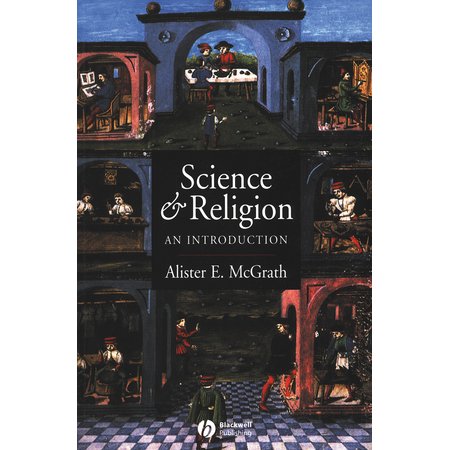
[Book] "Science and Religion: An Introduction"

Science and Religion: An Introduction
By:
Alister E. McGrath
Blackwell Publishing / 1998 / Paperback

Book Description:
This text introduces readers to the fascinating interaction of science and religion. It is specifically designed for students on science and religion courses who have little or no prior knowledge in either area. The book offers unusually wide coverage, looking at the historical, theological, philosophical and scientific aspects of the interaction of science and religion. It is also thoroughly up-to-date, and includes interaction with issues raised by Richard Dawkins concerning evolution, and the 'anthropic principle' in relation to cosmology. Although focusing mainly on Christianity, the text also indicates the importance of other religions.

[Book] "The Dawkins Delusion?"

The Dawkins Delusion? Atheist Fundamentalism and the Denial of the Divine
By: Alister E. McGrath, Joanna Collicutt McGrath
More in Veritas Forum Books Series
Inter-varsity Press / Hardcover

Book Description:
World-renowned scientist Richard Dawkins writes in The God Delusion: "If this book works as I intend, religious readers who open it will be atheists when they put it down." The volume has received wide coverage, fueled much passionate debate and caused not a little confusion.

Alister McGrath, along with his wife Joanna, are ideal to evaluate Dawkins's ideas. Once an atheist himself, he gained a doctorate in molecular biophysics before going on to become a leading Christian theologian. He wonders how two people, who have reflected at length on substantially the same world, could possibly have come to such different conclusions about God. McGrath subjects Dawkins's critique of faith to rigorous scrutiny. His exhilarating, meticulously argued response deals with questions such as: Is faith intellectual nonsense? Are science and religion locked in a battle to the death? Can the roots of Christianity be explained away scientifically? Is Christianity simply a force for evil? This volume is a Veritas Forum Book.

Publisher's Weekly:
When authors write books that criticize other books, they have usually already lost; the original book has set the agenda to which the critics respond, and the outcome is foretold. Not in this case. The McGraths expeditiously plow into the flank of Dawkins's fundamentalist atheism, made famous in The God Delusion, and run him from the battlefield. The book works partly because they are so much more gracious to Dawkins than Dawkins is to believers: [teci: They say(?}] Dawkins's The Blind Watchmaker "remains the finest critique" of William Paley's naturalistic arguments for deism available, for example. The authors can even point to instances in which their interactions with him, both literary and personal, have changed his manner of arguing: he can no longer say that Tertullian praised Christian belief because of its absurdity or that religion necessarily makes one violent. The McGraths are frustrated, then, that Dawkins continues to write on the a priori, nonscientific assumption that religious believers are either deluded or meretricious, never pausing to consider the evidence not in his favor or the complex beliefs and practices of actual Christians. They conclude disquietingly: perhaps Dawkins is aware that demagogic ranting that displays confidence in the face of counterevidence is the way to sway unlearned masses. (July) Copyright 2007 Reed Business Information.

science and God, dancing and architecture

Talking about music is like dancing about architecture. --- Steve Martin

Thanks to this entry, I now know that people are starting to say that there is something “before” the Big Bang :) Well, whether there is or not, I say that there is something “beyond” the Big Bang until now, something that science cannot directly observe nor measure, hence something that science cannot address.

Some people think that God is not real simply because God is not “scientific”. In fact, it is science that has built-in limitations, not God. :) Science deals only with what can be observed, measured, and repeated. God is none of those --- or to be more accurate, God reveals Himself when and how He wants to; we have no control of the situation.

But the scientific practices of observation, experimentation, and critical thinking need NOT be thrown out the window. Thankfully, these can and are being applied to the Christian life...just not in the same way that the "hard sciences" do it. Heck, it's not even in the same way that the "soft sciences" do it!

There's a lot of chauvinism in my field (science, particularly, physics). i'd rather not elaborate! ;p

But regarding atheists who reject God in the name of science, thankfully it is easier to explain than dancing about architecture :) (or talking about music, at least for me! ;p)